The wonderful thing about living 15 minutes outside of Washington, DC is the chance to interact regularly with people who serve our country. The hard things are the traffic and the divisive political conversations that trickle into cocktail parties and daily business.
I have been fortunate to get to know Senators, Members of Congress, Mayors, City Council and County Board members through my daily proximity to DC. All come to their service with different backgrounds. I have come to see that those who have worked in business, particularly those who have run their own businesses, as the hardest working and most balanced politicians.
The opportunity to support one of these families with their grant strategy came after years of my steady engagement with local organizations. The family held a 20 year old family foundation and was ready to refocus and bring their children into the family giving strategy.
Politicians and their spouses are asked, and feel compelled, to contribute to organizations across a wide range of issue areas. This family was no exception. With hundreds of small grants each year and interests running the gamut, they were unclear what their impact was or what kind of meaningful difference they were making.
It was hard to track cumulative investment over time, and just as hard to see whether the giving matched their values.
Turning Frustration into Focus
In a nutshell: they were frustrated. All their funding, and the hard work behind having that funding, didn’t add up to something that made sense to them.
And they wanted to engage their children but weren’t sure how to talk with them about the work they had done for 20+ years.
Their office handed me a spreadsheet with the 20+ years of grants. Multiple tabs, detailed organization information, amounts from $250 to $25,000, and hundreds of organizations. For this data fiend, it was a dream. I have never met a spreadsheet I didn’t like.
Taking unconnected data and making sense of it has been one of my favorite things to do since my days as a major gifts officer at Davidson College. Trends and threads and connections are always there. You just have to know where to start.
What emerged was remarkable. Out of the massive spreadsheet came focus.
Our Process
- Ran categories on each grant so we could aggregate across focus areas. Seven focus areas emerged.
- Generated numbers on earlier giving, the full portfolio, and the most recent five years.
- Compared recent giving in those seven areas against the first fifteen years.
- Narrowed to five categories after identifying two areas that had been steadily declining and no longer reflected the family’s current priorities, even though they reflected the foundation’s history and evolution.
- Identified one core focus area that represented 37% of all giving, with increased focus, and two areas that were steadily growing in recent years.
- Categorized grants as local, regional, national, and international, reflecting both their community roots and their civic engagement across the country.
The Structure and the Strategy
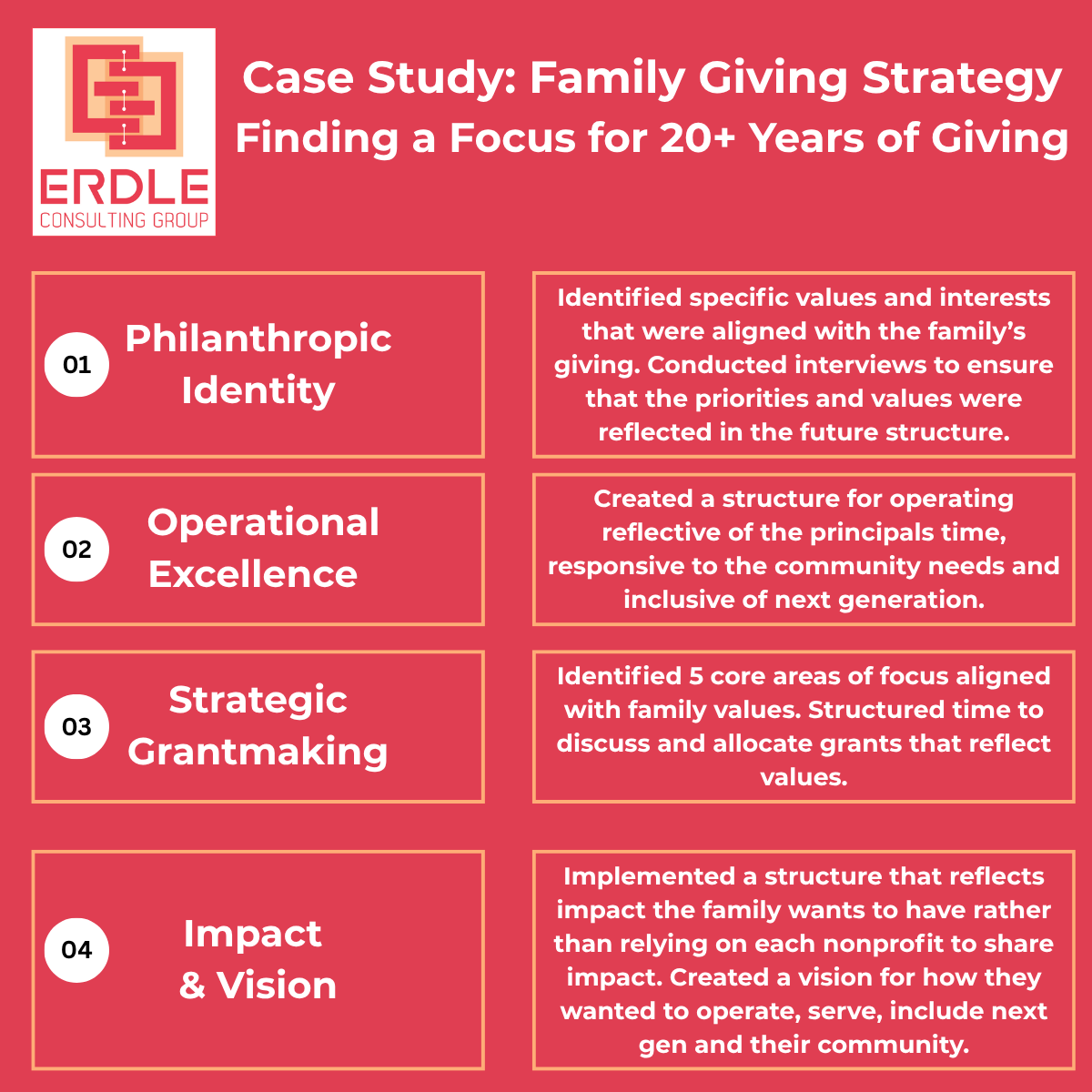
Once the grants were categorized, it became clear where their values lived. This guided me towards the questions I needed to ask to shape a structure and a family giving strategy. Here is what we did:
- Interviewed all 5 family members about their values, interests, and time available to participate.
- Developed a giving structure that preserved the parents’ focus areas while allocating specific funds for each child to direct toward their own interests.
- Planned quarterly gatherings and giving cycles aligned with fiscal year timing, such as year-end campaigns and educational institution mid-year deadlines, so the family could give more thoughtfully and intentionally instead of reactively, as they had in the past.
So, what did all this accomplish?
- A happy family who feels good about their grantmaking focus and can track the impact of their giving, past and future.
- A structure that makes room for real discussion, focus, and research, while staying flexible enough to meet nonprofit timing and respond to need.
- A system that reflects consensus on family values while honoring individual and next generation interests.
- A stronger family connection that grows alongside the children, deepening their relationships with the communities they serve and their understanding of what each grant means.
- An opportunity to serve their community in a stronger and more focused way with better understanding of their impact.